


Research Areas
Early Diagnosis of Alzheimer’s Diseases
 Alzheimer's disease (AD) was first described in 1906 by Alois Alzheimer, is a slowly progressive disease of the brain that is characterized by impairment of memory and eventually by disturbances in reasoning, planning, language, and perception. During the course of the disease, proteins build up in the brain to form structures called ‘plaques’ and ‘tangles’. This leads to the loss of connections between nerve cells, and eventually to the death of nerve cells and loss of brain tissue.
The likelihood of having Alzheimer's disease increases substantially after the age of 70 and may affect around 50% of persons over the age of 85. Nonetheless, Alzheimer's disease is not a normal part of aging and is not something that inevitably happens in later life. For example, many people live to over 100 years of age and never develop Alzheimer's disease.
It’s important to remember that Alzheimer’s is hard on family caregivers too. They often pay a high toll for their labour of love, reporting high levels of stress and sadness, and also increased health problems.
Alzheimer's disease (AD) was first described in 1906 by Alois Alzheimer, is a slowly progressive disease of the brain that is characterized by impairment of memory and eventually by disturbances in reasoning, planning, language, and perception. During the course of the disease, proteins build up in the brain to form structures called ‘plaques’ and ‘tangles’. This leads to the loss of connections between nerve cells, and eventually to the death of nerve cells and loss of brain tissue.
The likelihood of having Alzheimer's disease increases substantially after the age of 70 and may affect around 50% of persons over the age of 85. Nonetheless, Alzheimer's disease is not a normal part of aging and is not something that inevitably happens in later life. For example, many people live to over 100 years of age and never develop Alzheimer's disease.
It’s important to remember that Alzheimer’s is hard on family caregivers too. They often pay a high toll for their labour of love, reporting high levels of stress and sadness, and also increased health problems.
Scientists don’t yet fully understand what causes Alzheimer’s disease in most people. There is a genetic component to some cases of early-onset Alzheimer’s disease. Late-onset Alzheimer's arises from a complex series of brain changes that occur over decades. The causes probably include a combination of genetic, environmental, and lifestyle factors.
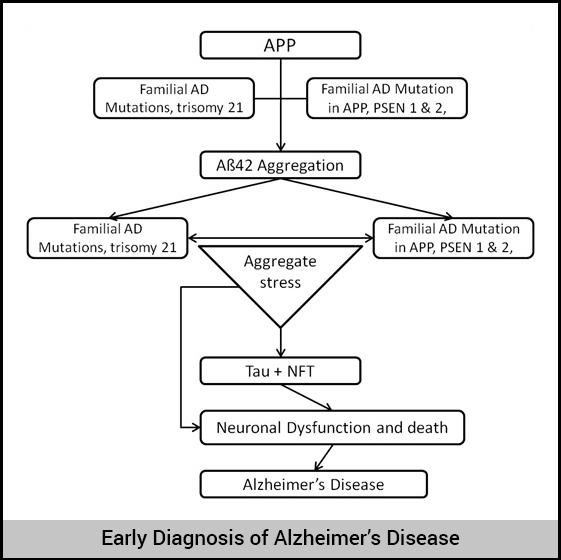
There is two molecular mechanism involved in diagonosis for alzheimer disease – 1. Amyloid cascade hypothesis and 2. Tau protein hypothesis
Beta-amyloid is a small piece of a larger protein called “amyloid precursor protein” (APP). When APP is “activated” to do its normal job, it is cut by other proteins (beta-secretase/Gamma Secretase) into separate, smaller sections that stay inside and outside cells. There are several different ways APP can be cut; under some circumstances, one of the pieces produced is beta-amyloid. Beta-amyloid is chemically “stickier” than other fragments produced when APP is cut. It accumulates in stages into microscopic amyloid plaques that are considered a hallmark of a brain affected by Alzheimer’s. The tau hypothesis states that excessive or abnormal phosphorylation of tau results in the transformation of normal adult tau into PHF-tau (paired helical filament) and NFTs (neurofibrillary tangles). Tau protein is a highly soluble microtubule-associated protein (MAP).
Between 2000 and 2015 deaths from heart disease have decreased 11% while deaths from Alzheimer’s have increased 123%. There is no specific test today that confirms you have Alzheimer's disease. Alzheimer's disease can be diagnosed with complete accuracy only after death, when microscopic examination of the brain reveals the characteristic plaques and tangles. To help distinguish Alzheimer's disease from other causes of memory loss, doctors now typically rely on the different types of tests. Physical and neurological exam, amyloid deposition diagnosis from CSF, blood test for dementia causes due to vitamin deficiency, MRI, CT scan and PET.
Early and accurate diagnosis could save up to $7.9 trillion in medical and care costs. Late diagnosis of Alzheimer’s disease (AD) may be due to diagnostic uncertainties. We aimed to determine the sequence and timing of the appearance of established early signs and symptoms in people who are subsequently diagnosed with AD. We are intended to develop a Diagnostic kit, a diagnostic marker and a detection method for differentially diagnosing the Alzheimer's disease at an earlier stage condition based on protein involved AD.