


Research Areas
Development of –Omics based treatment technologies for textile waste
India is the largest cotton producing and second largest cotton exporting country in the world. The textiles sector is one of the largest contributors to India’s economic growth, financial empowerment and provide employment to millions of people directly or indirectly. The textile industry is composed of organised and unorganised sector consisting of handlooms and handicrafts which are based on traditional methods. On the other hand, modern industries are large apparel houses and garment segments. Gujarat is a major textile-manufacturing hub in the country.
The Ahmedabad city, also known as the Manchester of the East and Denim City and Surat in South Gujarat is known as the Synthetic Capital. Gujarat has highest number of medium and large textile processing houses, printing units composed of natural and synthetic fibres in the Country. The textile industry is using millions of tons of synthetic pigments and chemical dyes in the manufacturing process. A large amount of these textile dyes and pigments are lost during the finishing process and discharged as industrial effluents at various stages. The presence of azo and vat dyes, sodium silicates, formaldehyde based dye fixing agents, softeners and non-biodegradable agents soaps and detergents and heavy metals is a continuous threat to all living beings.
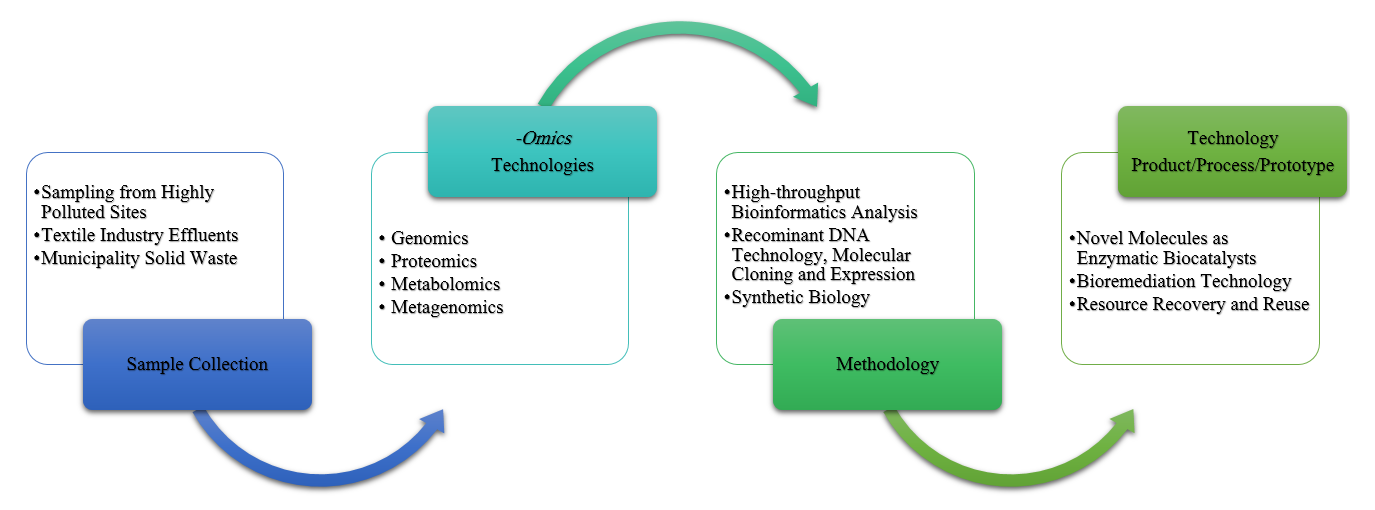
The fundamental objective of our Research Group is to tackle major environmental problems and societal challenges through biotechnological interventions and development of integrated bioremediation technology, enzymatic biocatalysts, resource recovery and reuse through multi-disciplinary approaches. The next generation whole genome shotgun sequencing of the environmental samples from highly polluted sites could accelerate the high-throughput translational research efforts for the treatment of industrial effluents and solid waste management. The functional meta-omics allows us the discovery of unique genes encoding exceptionally competent enzymes acting as novel biocatalysts. The recent advances in synthetic biology and genome editing help in better experiment design and process optimisation parameters with desired properties for the bioremediation of recalcitrant and xenobiotic compounds. The development of highly efficient enzymatic biocatalysts using molecular cloning and overexpression techniques in a suitable vector and host organisms for the biodegradation of major industrial pollutants causing various health hazards, soil pollution, ground water pollution and damage to the aquatic life. Thus, catering to the societal needs through innovative discoveries and accelerating translational applications and technologies.